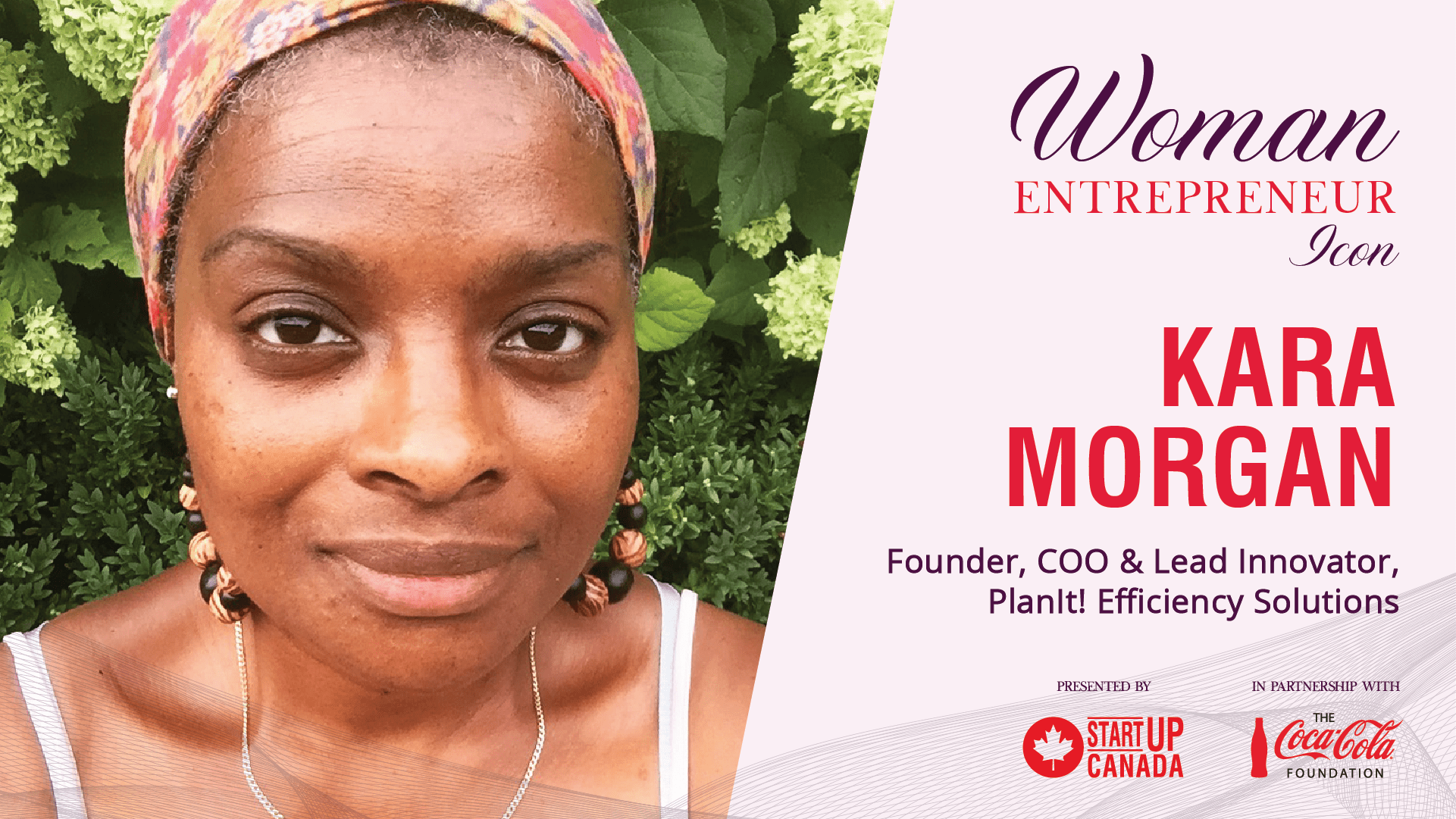
“When the sun shines, it shines for all of us, not just for those who think they deserve it more.”
In partnership with the Coca-Cola Foundation’s 10,000 Women Entrepreneurs Initiative, Startup Canada is celebrating and spotlighting leading Canadian Women Entrepreneurs. Startup Canada was pleased to sit down with Kara Morgan, Founder, COO & Lead Innovator of PlanIt! Efficiency Solutions to learn about her journey and the impact of her work.
With over 20 years of experience working in the public, private, and non-profit sectors, Kara Morgan has noticed something that is common among all three—waste. Wasted time, wasted effort, wasted resources, and wasted energy. A serial entrepreneur, Kara founded PlanIt!—first as an outsourcing company—to help businesses and organizations decrease waste.
Since founding the company, they’ve branched out into other verticals including cleantech. They take a holistic approach to increasing efficiency through project management and change management methodologies to deliver innovative, scalable, measurable solutions to common operational challenges.
Kara is also a contributing writer for Mompreneur, UPS Small Business Canada, Silicon Halton, and Medium.
SC: In one sentence, what does being an entrepreneur mean to you?
KM: Being an entrepreneur means having the ability to forge your own path while fulfilling your purpose or passion, and having the tenacity to take certain risks to make that happen.
SC: Tell us about your entrepreneurial ventures and what role they’ve played in your life.
KM: My first venture happened about 28 years ago, I had an online black Bookstore at a time when the internet wasn’t the friendliest space. I sold black history books and multilingual books for adults and children. I wanted to feature Caribbean authors and multilingual children’s books because at the time there weren’t very many out there in regular bookstores.
My second venture is PlanIt! Outsourcing Solutions. It started as an administrative consulting business, which I then expanded into a process improvement and efficiency business that focused on operations. Now we have evolved to focus more on efficiency and sustainability.
With this business, I wanted to help other businesses build capacity and structure into their operations in a way that benefits them—meaning their profits, their clients, and the environment.
SC: What motivated or propelled you to become an entrepreneur?
KM: In the corporate world, it was very challenging for me to get appropriate recognition or pay for the work that I was doing. For years, I was doing project management but only got paid as an analyst.
There were times when I trained people to work in our department, and they got promoted, and I didn’t. People came up to me kind of bug-eyed like, “what happened?” That was a very challenging environment for me.
On the personal side, when my children were born, I felt it necessary to not only be in their lives, but have that flexibility that I could do things with them or stay home as necessary. I didn’t have that with my corporate job and I felt that working on my own, using my own talents, and using the skills that I had acquired would be more beneficial and more financially satisfying in the long run.
SC: What are you most proud of related to your ventures?
KM: We’re focusing more on sustainability and efficiency, and outcomes for society.
For our workers, we really wanted to help more women—particularly those from single-income households—become more financially stable. I think that entrepreneurship, when it works, is the way to do that.
For our clients, we want to have tools, products, and services that allow them to sustain efficient operations and also contribute to sustainability—and that makes me very proud.
SC: What inspires you to keep going?
KM: What inspires me is knowing how many people we can help and offer relief to. It’s all about impact!
SC: What’s the next mountain you’re climbing and what’s still left undone?
KM: Right now we’re trying to embark on onboarding and training 100 women to become owner-operator-installers for our solar-blind product. It’ll be a challenge to source out 100 women that fit the particular profile, so we’re looking for an agency that either services newcomers that are mostly women, or female-lead single-income households.
SC: What has been your biggest learning along the way?
KM: Do whatever it takes to figure out who your target market is. That’s what’s taken the longest to nail down because process improvement and efficiency is very broad. Doing this part of the work really helped me focus on the market, message, marketing plan, and even where to network. Once I was able to figure that out, it was so much easier.
SC: Have you identified or confronted any systemic barriers through your journey? How do you persevere through them?
KM: A little bit of everything, actually. I’ve been hit on by men before who pretended to be interested in my business—but weren’t.
I’ve experienced racism—some overt forms—but it’s mostly covert in the sense that it’s invisible to people who don’t recognize it. It’s undertones and microaggressions. It’s in the background—like not getting a promotion, or not being allowed into certain places, or being treated differently, but you can’t quite put your finger on it. In Canada, that’s typically how it works out.
I’ve experienced sexism before. We’re classified under the construction industry and the tech industry. Both industries are very heavily male-dominated and there’s not a lot of space for female entrepreneurs—let alone female entrepreneurs of colour.
Sometimes people talk down to you, especially when you’re in those environments where you have to speak about technical properties. They think they have to explain everything to you because you don’t know what’s going on, or they test you to see if you know what you’re talking about.
SC: Would you say that entrepreneurship puts you in the driver’s seat a little more?
KM: Absolutely. For a lot of the people that I’ve spoken to, getting into the entrepreneurial space was the way to control who you work with. When you’re employed by someone, you don’t always have that choice.
I still think we need to be realistic and remember that Canada is built on institutionalized systems that don’t always benefit everyone. I think if you’re a woman or person of colour In Canada, it’s very prevalent. Sometimes you get the sense that, “Oh, it’s just me, I’m just not doing this right or I’m not writing this properly or I’m not saying this properly, or I need to jump through this hoop.” No, it’s not you at all. It’s the system. That’s the way it was built.
SC: What advice do you have for those just beginning to embark on their entrepreneurial journey?
KM: Make sure that you have some form of financial security in place. That might mean starting your business part-time, while you work your full-time job, or working part-time at your paid job while your business becomes sustainable.
I think for a lot of entrepreneurs, we have a pie-in-the-sky ideal. We think that the business is going to take off the first year, even though there have been many studies that prove that it doesn’t hit until your fifth year. It happens for some niche technologies, but that’s not the rule by any means. You need to have some kind of financial cushion to get you through those periods.
SC: What do you think today’s entrepreneurs should be focused on for a better, brighter future?
KM: I think entrepreneurs need to focus on products and services that serve more than one social need. In other words, help others—not just yourself. I always like to say this; when the sun shines, it shines for all of us, not just for those who think they deserve it more. I would hope entrepreneurs would build businesses that have that kind of overtone. If one person’s winning, that’s great. If we all win, that’s the best outcome.
Are you on a quest to help us all win? Join the Startup Canada Women Entrepreneurs Network to gain access to resources, community events, and more!