February 9, 2025 — Ottawa
On February 9th, Startup Canada, as part of its Startup Gov programming, partnered with Meta to host a closed-door roundtable in Ottawa. The gathering brought together founders and innovators who have built and deployed solutions using open-source AI models, including Meta’s Llama, for an honest conversation about what’s working, what isn’t, and what needs to change.
Each entrepreneur had the opportunity to engage directly with MP Taleeb Noormohamed, Parliamentary Secretary to the Minister of Artificial Intelligence and Digital Innovation, to discuss Canada’s AI landscape, surface real barriers to adoption and commercialization, and propose actionable pathways to strengthen Canada’s global competitiveness. The group was also joined by Anna Hermansen of the Linux Foundation, who shared key findings from a new report: The Value of Open-Source AI for the Canadian Economy.
What emerged was a candid, energized conversation – one that balanced genuine optimism about Canada’s potential with clear-eyed frustration about the gaps holding us back.
Where Canada Stands
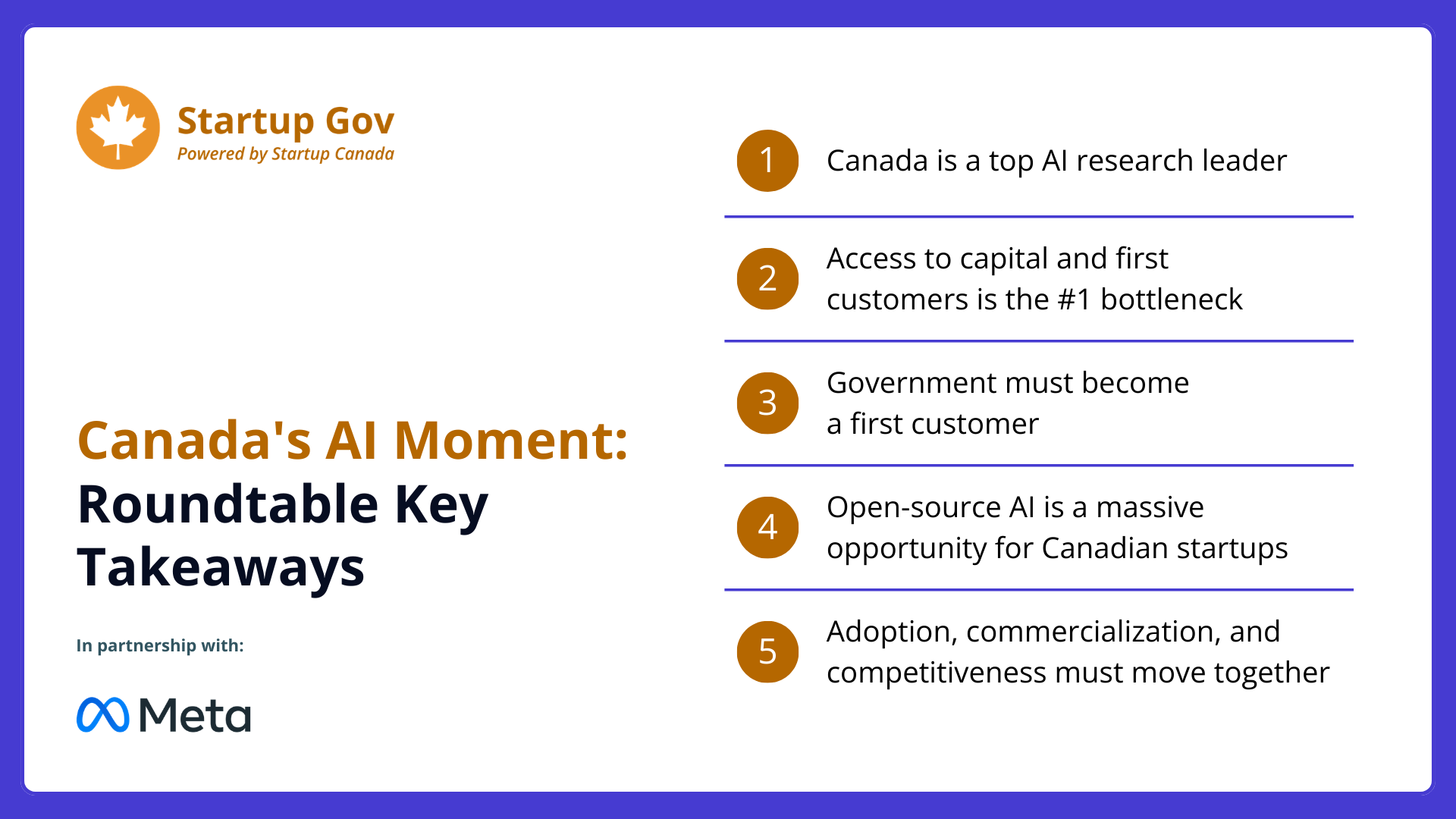
Canada’s AI credentials are real. The country remains a top-five global AI research leader, backed by strong government investment and a vibrant private sector. The talent is here. The ideas are here. And AI is creating new opportunities to democratize access, build trust, and broaden participation across industries, with projections of up to 35,000 new innovative jobs supported by AI in Canada over the next five years.
But there’s a persistent and widening gap between research excellence and commercial impact. Canadian businesses are still largely in a “crawl/walk” phase when it comes to AI adoption. Legacy systems, perceived data privacy constraints, and low enterprise uptake are real friction points. The country is producing world-class AI research and then watching the economic benefits flow elsewhere.
The Key Challenges
The roundtable gave founders space to speak plainly, and they did.
The commercialization gap was front and center. Canada is widely seen, at home and abroad, as a research hub, not a place to scale. Early-stage companies aren’t just struggling to raise funds; they’re struggling to find their first paying customers. Without revenue, many founders are making the difficult decision to relocate to the United States, where capital is more available, investor risk appetite is higher, and the path to growth is clearer.
The adoption gap compounds the problem. When Canadian businesses don’t adopt AI at scale, homegrown companies lose the domestic market traction they need to prove their models. Adoption requires tools that are accessible, trusted, and easy to integrate, and that kind of ecosystem takes deliberate effort to build.
Capital barriers are systemic. Founders described a landscape where Canadian companies face higher bars to investment than their American counterparts, where early-stage rounds are undercut by the mismatch between what grants offer (often $25K) and what growth actually requires (often $1M+), and where Canadian institutional investors remain largely on the sidelines.
Ecosystem fragmentation rounds out the picture. Canada has over 375 accelerators and incubators, which is an impressive number on paper. But founders were candid: the administrative overhead is high, and conversion rates to scaled companies are low. Meanwhile, the grassroots AI communities, such as hackathons, hacker houses, and community labs that tend to organically generate talent and momentum, remain underdeveloped compared to what’s happening in other innovation ecosystems globally.
What Founders Are Building and What They Need
The founders in the room were working across a remarkable range of sectors: robotics, healthcare, wearables, wildfire technology, automation, and human-centric AI. Diverse as their work was, they were unified on a few core themes.
Open-source models are creating enormous opportunity. The ability to build on, customize, and trust open models changes what’s possible, especially for smaller teams without the resources to develop proprietary foundation models from scratch.
But access to capital remains the primary bottleneck. Not just venture capital, but early revenue. The ability to show a contract, a customer, or a real deployment is what unlocks the next round. Without it, staying in Canada is a harder and harder decision to justify.
Government procurement came up repeatedly, not as an abstract policy lever, but as a lived frustration. The consensus: procurement is too slow, too risk-averse, and too often structured in ways that exclude the early-stage companies most likely to be doing genuinely innovative work.
The Strategic Levers
The conversation didn’t stop at problems. Founders and policymakers worked through a set of concrete opportunities.
Government as a first customer. Federal and provincial departments could serve as test environments for Canadian AI solutions, not just as regulators or funders, but as early adopters. Restructuring grants as procurements is a particularly compelling idea: rather than handing a startup a non-dilutive grant with no strings attached, the government pays for a product or service. The company gets revenue. With contracts in hand, private capital becomes easier to raise. It’s a structural shift that could meaningfully change the math for early-stage founders.
Capital and investment reform. Ideas ranged from angel matching programs to a Canadian sovereign fund designed to take early, higher-risk bets on domestic AI companies. The throughline was the need to incentivize domestic VC participation and make visible the real pathways to profitability that do exist for Canadian AI companies.
A grassroots AI ecosystem. Nationally supported and independently judged hackathons with meaningful funding, transparent selection, and genuine public visibility could do a lot to build momentum and surface talent. Community labs and hacker houses could democratize access to AI development and accelerate adoption beyond the startup community into small businesses and underserved sectors.
Sector prioritization. Canada doesn’t need to compete everywhere. There are areas where the country has genuine, durable advantages: natural resources and AI, healthcare and large language models, emergency preparedness and climate resilience. Focusing energy and investment in these verticals — while ensuring solutions are safe, responsible, and globally relevant is a more winnable strategy than trying to replicate Silicon Valley.
The Mindset Shift
Perhaps the most important theme of the day wasn’t a policy or a program. It was a call for Canada to believe in its own potential.
Canada has a habit of undervaluing its own innovation. Founders who build here, exit here, and then leave, often because there’s no compelling reason to stay, represent a quiet but significant loss. The capital, the knowledge, and the networks leave with them.
Changing that requires alignment across policymakers, investors, and industry around three priorities: adoption, commercialization, and global competitiveness. Not sequentially, but rather, simultaneously.
As one participant put it: “We have a real moment – scope for AI is unlimited. The question is whether Canada will seize it.”

This post was produced by Startup Canada based on insights from the February 9, 2025, closed-door roundtable held in Ottawa in partnership with Meta, as part of the Startup Gov programming series.